What are the Odds in Blackjack? Master Your Game!

A close-up of poker chips and playing cards on a casino gaming table, highlighting Ace of Diamonds.Photo: Elian Emanuel Coutinho Roehrs / Pexels

What are the Odds in Blackjack? Master Your Game!

Unlock the secrets of blackjack probability and strategy to significantly enhance your winning potential at the tables.

Play Smarter Now

Key Takeaways

  • ✓ The house edge in blackjack is typically around 0.5% to 2% with basic strategy.
  • ✓ Player decisions significantly impact the odds; optimal strategy is crucial.
  • ✓ Card counting can give the player an advantage, but is difficult and often prohibited.
  • ✓ Different rule variations (e.g., number of decks) affect the odds.

How It Works

1
Understand Basic Blackjack Rules

Familiarize yourself with how the game is played, including card values, hitting, standing, splitting, and doubling down. A solid grasp of the fundamentals is the first step to understanding the odds.

2
Learn Optimal Basic Strategy

Memorize and apply the mathematically proven basic strategy chart for every possible hand combination. This minimizes the house edge to its lowest possible point, often below 1%.

3
Recognize Rule Variations

Be aware that different blackjack tables and casinos have varying rules, such as payout for blackjack, dealer hitting on soft 17, or surrender options. These rules directly impact the game's odds.

4
Practice and Manage Bankroll

Regular practice, whether online or with friends, solidifies your strategy. Always manage your bankroll responsibly to ensure you can withstand natural fluctuations in luck.

Demystifying Blackjack Odds: The Core Mathematics

A casino dealer handling cards at a gaming table, ready for blackjack or poker.Photo: Anna Shvets / Pexels
Blackjack is often lauded as one of the casino games with the best odds for players, and for good reason. Unlike purely luck-based games such as roulette or slots, blackjack incorporates elements of skill and strategy that can significantly influence the outcome. To truly grasp what are the odds in blackjack, one must first understand the fundamental mathematical probabilities at play. At its core, the game revolves around drawing cards to reach a total closer to 21 than the dealer, without exceeding 21. Each card in the deck has a specific probability of being dealt, and these probabilities shift with every card drawn. For instance, the probability of drawing a 10-value card (10, Jack, Queen, King) is significantly higher than drawing any single specific card, given there are 16 such cards in a standard 52-card deck. This simple fact underpins much of blackjack strategy. The house edge, a term frequently heard in casino discussions, represents the casino's built-in advantage over the player in the long run. In blackjack, with optimal basic strategy, this edge can be as low as 0.5% to 1%. This is remarkably low compared to other casino games, where the house edge can easily climb to 5% or even 10%+. However, this low edge is contingent upon the player making statistically correct decisions based on their hand and the dealer's upcard. Deviating from basic strategy, even slightly, can quickly escalate the house edge, turning a potentially profitable game into a losing one over time. The mathematical calculations behind basic strategy charts are derived from millions of simulated hands, determining the play that maximizes the player's expected return in every scenario. Understanding the composition of the deck and the likelihood of certain cards appearing is paramount. For example, knowing the probability of busting if you hit on a 16 against a dealer's 10 is what informs the basic strategy decision to hit or stand. The odds are not static; they are dynamic, constantly changing with each card dealt from the shoe. This dynamic nature is what makes blackjack so engaging and, for strategic players, potentially rewarding. Mastering these probabilities is the first step towards truly understanding and improving your performance at the blackjack table. For more insights into gambling probabilities, explore further resources. Furthermore, the number of decks used in the game plays a crucial role in altering these probabilities. A single-deck game generally offers slightly better odds to the player than a multi-deck game, assuming all other rules are equal. This is because in a single-deck game, the impact of specific cards being removed from play is more pronounced, making it easier for players (and card counters) to estimate the remaining card distribution. As more decks are added, the impact of any single card's removal is diluted, making the deck composition less predictable. However, single-deck games are becoming rarer in casinos, often accompanied by less favorable rules (like 6:5 blackjack payouts instead of 3:2) to compensate for the improved odds. Therefore, a comprehensive understanding of what are the odds in blackjack requires not just knowing the general probabilities but also how specific game rules and deck configurations modify them. It's a nuanced interplay of mathematics, rule variations, and player decisions that ultimately determines the long-term outcome. The savvy player doesn't just play; they calculate, observe, and adapt.

The Impact of Player Strategy on Blackjack Odds

A casino dealer handling cards at a gaming table, ready for blackjack or poker.Photo: Anna Shvets / Pexels
While the inherent mathematical structure of blackjack provides a baseline for what are the odds in blackjack, it is the player's strategy that truly dictates their individual winning potential. Unlike games where player decisions have no bearing on the outcome, blackjack empowers the player to make choices that directly influence the house edge. The cornerstone of effective play is basic strategy, a set of mathematically derived rules that tells the player the optimal action (hit, stand, double down, split, or surrender) for every possible combination of their hand and the dealer's upcard. Adhering to basic strategy is not just recommended; it's essential if you want to minimize the casino's advantage and play as close to even money as possible. Ignoring basic strategy, or making decisions based on 'gut feelings' or superstitions, will dramatically increase the house edge against you, often turning a game with a sub-1% house advantage into one with a 2-5% or even higher disadvantage. Consider the common scenario of holding a hard 16. Basic strategy dictates that you should stand if the dealer shows a 2, 3, 4, 5, or 6, but hit if the dealer shows a 7, 8, 9, 10, or Ace. These recommendations are not arbitrary; they are based on extensive probability calculations that determine which action gives you the highest long-term expected return. For example, against a dealer's 10, hitting a 16 is statistically the better play, even though it feels risky, because the probability of the dealer busting or you improving your hand outweighs the risk of busting yourself. Conversely, standing on 16 against a dealer's 6 is correct because the dealer is highly likely to bust. These are the kinds of specific, data-driven decisions that define basic strategy and protect your odds. Many casinos even allow players to use basic strategy cards at the table, a testament to its legality and effectiveness in simply bringing the game closer to its theoretical optimal play. Beyond basic strategy, more advanced techniques like card counting exist, which can actually shift the odds in favor of the player. Card counting is not about memorizing every card; it's about keeping a running tally of high-value versus low-value cards remaining in the shoe. When the shoe is rich in high cards (10s, Aces), the player's odds improve, and they can increase their bets accordingly. Conversely, when the shoe is rich in low cards, the odds favor the dealer, and the player can reduce their bets. While highly effective, card counting requires significant practice, concentration, and is often frowned upon or prohibited by casinos. Even without card counting, mastering basic strategy is the single most important factor in determining what are the odds in blackjack for an individual player. It transforms the game from one of pure chance into one where informed decisions significantly impact your success rate over time. Without it, you are simply giving the casino a much larger edge than necessary, making consistent winning an almost impossible feat.

Decoding Blackjack Rule Variations and Their Effect on Odds
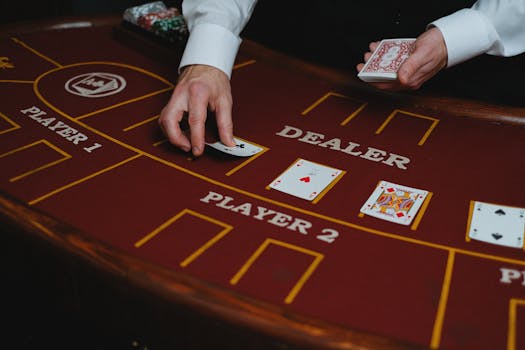
A casino dealer distributes playing cards at a poker table, ready for a game.Photo: Anna Shvets / Pexels
The world of blackjack isn't uniform; casinos globally, and even within the same casino, offer tables with varying rule sets. These seemingly minor differences can significantly impact what are the odds in blackjack, either improving or worsening the player's long-term prospects. Being an informed player means not just knowing basic strategy but also understanding how these rule variations swing the house edge. One of the most critical rules is the payout for a natural blackjack (an Ace and a 10-value card). Historically, blackjack paid 3:2, meaning a $10 bet would win $15. However, many casinos now offer 6:5 payouts, where a $10 bet wins only $12. This single rule change is detrimental to the player, increasing the house edge by approximately 1.4% to 2% — a massive difference that can turn a favorable game into a losing one. Always seek out 3:2 blackjack tables. Another significant rule is whether the dealer hits or stands on a 'soft 17' (an Ace and a 6). When the dealer hits on soft 17 (often denoted as 'H17'), it slightly increases the house edge, typically by about 0.2%. This is because hitting a soft 17 gives the dealer more opportunities to improve their hand without busting, which is to the player's disadvantage. Conversely, if the dealer stands on soft 17 ('S17'), it's a more favorable rule for the player. The ability to double down is another key factor. Some tables restrict doubling down to specific totals (e.g., only on 10 or 11), while others allow doubling on any two cards. The more liberal the doubling rules, the better for the player, as it allows them to maximize their winnings in favorable situations. Similarly, the option to 'surrender' (giving up half your bet and your hand in unfavorable situations) can reduce the house edge by about 0.07% if used correctly, particularly against a dealer's 10 or Ace when you have a stiff hand like 15 or 16. Understanding these nuances is key to responsible gambling. Furthermore, the number of decks in play, as mentioned, affects the odds. Fewer decks generally mean a lower house edge, as the probabilities of specific cards appearing are more predictable. However, this advantage is often negated by other unfavorable rules at single-deck tables. Other rules like 're-splitting Aces,' 'dealer peeks for blackjack,' and restrictions on 'splitting pairs' also contribute to the overall house edge. A table that allows re-splitting Aces is more player-friendly. A table where the dealer peeks for blackjack before players make decisions prevents unnecessary doubling or splitting against a potential dealer blackjack. In summary, a discerning blackjack player doesn't just look for an open seat; they scrutinize the table rules, understanding how each variation impacts what are the odds in blackjack. Prioritizing tables with 3:2 payouts, dealer stands on soft 17, and liberal doubling/splitting rules will give you the best mathematical chance of success.

Optimizing Your Chances: Tips to Improve Your Blackjack Odds

A casino dealer handling cards at a gaming table, ready for blackjack or poker.Photo: Anna Shvets / Pexels
Improving what are the odds in blackjack isn't about magic; it's about discipline, knowledge, and strategic play. For players who aren't card counters, the primary goal is to minimize the house edge through consistent application of basic strategy and intelligent table selection. Here are actionable tips to help you optimize your chances: * **Master Basic Strategy:** This cannot be stressed enough. Print a basic strategy chart and use it until it becomes second nature. It's the single most impactful thing you can do to reduce the house edge. Don't guess; consult the chart for every hand. * **Seek Favorable Rules:** Prioritize tables offering 3:2 blackjack payouts. Avoid 6:5 tables at all costs, as they significantly increase the house edge. Look for tables where the dealer stands on soft 17 (S17) rather than hits (H17). More liberal rules for doubling down (e.g., on any two cards) and splitting (e.g., re-splitting Aces) are also beneficial. * **Fewer Decks, If Rules Are Equal:** While single-deck games typically offer better odds, always check the other rules. A 6:5 single-deck game is worse than a 3:2 eight-deck game. If all other rules are identical, fewer decks are better. * **Utilize Surrender:** If available, learn when to use the surrender option. It's a mathematically correct play in specific situations, such as having a hard 16 against a dealer's 9, 10, or Ace, or a hard 15 against a dealer's 10. This can save you money in the long run. * **Manage Your Bankroll:** Set a budget and stick to it. Never chase losses. Responsible bankroll management ensures you can withstand the natural fluctuations of the game and play for longer, allowing the long-term probabilities to even out. * **Avoid Side Bets:** Most blackjack side bets, such as 'Perfect Pairs' or '21+3', have a significantly higher house edge than the main game. While they offer tantalizing payouts, they are designed to take your money faster. Stick to the main game for the best odds. * **Practice Online:** Before playing for real money, practice extensively with free online blackjack games. This allows you to hone your basic strategy without financial risk, building confidence and consistency. By diligently applying these tips, you can ensure you are playing blackjack with the best possible odds available to a non-card-counting player. It transforms the game from a purely recreational activity into a strategic endeavor where informed decisions genuinely matter.

Comparison

Rule VariationImpact on House Edge (Approx.)Player AdvantageCasino Advantage
Blackjack Payout 3:2-1.4% to -2%
Blackjack Payout 6:5+1.4% to +2%
Dealer Stands on Soft 17 (S17)-0.2%
Dealer Hits on Soft 17 (H17)+0.2%
Single Deck Game-0.05% to -0.6%
Eight Deck Game+0.05% to +0.6%
Early Surrender Allowed-0.62%
No Surrender+0.62%

What Our Readers Say

5 ★★★★★

"This guide completely changed my perspective on what are the odds in blackjack. I used to just play by feel, but understanding basic strategy and rule variations has made my sessions so much more enjoyable and less costly. Highly recommend!"

5 ★★★★★

"As a casual player, I always wondered what are the odds in blackjack. This article broke down the math and strategy perfectly. I've started looking for 3:2 tables and my bankroll is definitely lasting longer."

5 ★★★★★

"The sections on rule variations were eye-opening. I had no idea how much a 6:5 payout hurt my chances. Thanks to this, I'm a much smarter player now, and I even won back my initial stake on my last trip!"

4 ★★★★☆

"Solid information on what are the odds in blackjack. While I'm still working on memorizing basic strategy perfectly, the advice on avoiding side bets and choosing tables wisely has already made a difference in my online play."

5 ★★★★★

"I used to think blackjack was pure luck. This article explains what are the odds in blackjack so clearly, emphasizing the skill aspect. It's inspired me to really learn basic strategy and play more intentionally."

Frequently Asked Questions

What is the best possible house edge in blackjack?
With optimal basic strategy and favorable rules (like 3:2 payout, dealer stands on soft 17, liberal doubling/splitting), the house edge in blackjack can be as low as 0.2% to 0.5%. This makes it one of the most player-friendly casino games.
Does card counting actually improve my odds?
Yes, card counting, when executed correctly, can shift the odds in favor of the player, giving them a mathematical advantage over the casino. However, it requires significant skill, practice, and is often prohibited by casinos, leading to expulsion if detected.
How important is basic strategy to the odds in blackjack?
Basic strategy is critically important. It represents the mathematically optimal play for every possible hand and significantly reduces the house edge to its lowest possible point. Playing without basic strategy can increase the house edge by several percentage points, making it much harder to win.
How do different rule variations affect the odds?
Rule variations have a substantial impact. For example, a 6:5 payout for blackjack dramatically increases the house edge by 1.4% to 2% compared to a 3:2 payout. Dealer hitting on soft 17 also slightly increases the house edge, while options like surrender or re-splitting Aces can slightly decrease it.
Is online blackjack different from live casino blackjack in terms of odds?
The underlying mathematical odds in online blackjack are generally the same as in live casinos, provided the rules are identical. However, online games often use random number generators (RNGs) and frequently reshuffle decks, making card counting ineffective. Always check the specific rules of the online game you are playing.
Who should focus on understanding blackjack odds?
Anyone who plays blackjack, from casual enthusiasts to serious players, should focus on understanding the odds. This knowledge empowers players to make informed decisions, select the best tables, and maximize their chances of success, transforming the game from pure chance into a strategic endeavor.
Are there any 'safe' bets in blackjack?
No bet in blackjack is entirely 'safe' as the game always has a house edge, however small. The 'safest' approach is to always follow basic strategy, avoid side bets, and choose tables with the most player-favorable rules to minimize the casino's advantage and play with the best possible odds.
What is the future trend for blackjack odds in casinos?
The trend in many casinos has been towards less player-favorable rules, such as more 6:5 blackjack payouts and dealer hits on soft 17, to increase their profit margins. However, competitive markets still offer better rules. Players will need to be more diligent in seeking out tables with superior rules to maintain favorable odds.

Armed with a clear understanding of what are the odds in blackjack and how to influence them, you're ready to elevate your game. Start applying these strategies today to play smarter, reduce the house edge, and enhance your winning potential at the blackjack tables.

Topics: what are the odds in blackjackblackjack house edgeblackjack probabilityblackjack strategywin at blackjack